Sunday, July 18, 2010


Friday, June 4, 2010
Bigger is better: Penguin exhibit at the Sea Life Park Tokyo
Within the last year I have visited sixteen penguin exhibits - mainly because of a penguin project I have been working on. I made the following observation: the larger the water body the more birds I saw in the water. Water motion, like waterfalls, jets, waves etc. also seem to be a major factor.
Sure, sixteen random visits are not a study, and it might have been all coincidental. But during my recent visit to Japan I came across four penguin exhibits, quite by chance and at different times, and these four exhibits mirrored my observation perfectly.
Of these four exhibits, three were rather small and all penguins were just standing on land, except for one where a few birds of the flock enjoyed water jets in a shallow pool.
The fourth exhibit however had a huge pool - probably the largest penguin pool I have seen in my life - and a wave machine. There all birds were in the water. This exhibit is located at the Sea Life Park Aquarium, Tokyo, and I will show it here.
Below is video that I shot at the underwater window. Seeing all these animals moving in a flock was impressive.
©2010 wild-design.com
Although the pool was huge the penguins loved swimming near the window and these curious animals seemed to be as interested in the visitor as they were in the birds.

On display were Humboldt penguins mixed with Rockhoppers, and in an area seperated by a fence they had a flock of Fairy penguins.
I didn't noticed the Rockhoppers when I was visiting but when I looked closer at the photo below I noticed that this is not a Humboldt penguin.

While this exhibit impressed me for its size, I was underwhelmed by what it had to offer the visitors. There was only one underwater viewing window and none for the Fairy penguins. The window had a high ledge, too high for smaller kids unless they were lifted right on it. And the upper window edge was rather low. Look at the guy on the left of the photo below and see how his eye level, water level and the upper window edge are on the same height. The underwater viewing was only accessible by staircases.
What was good was the length of the slightly concave window: ideal to observe the animals on their underwater flight.

The above water viewing was so high above the water table that it made it less interesting to observe the animals. The boy in the photo leaning over the railing is at least 2.5 meters (8') above the birds. There was no visitor viewing near the nest boxes which were all tucked away at the end and to the back of the exhibit.
 However, despite these short comings I enjoyed my stay at this exhibit and I liked it a lot for what it had to offer the birds. I was particularly impressed by the shear number of birds doing their synchronized swimming pattern: simply amazing! Here is a video clip that shows it from above:
The Fairy penguins are separated by a fence from the Humboldts and Rockhoppers.
In the background of the photo below you can see the next boxes. (You might need to click on it and look at the enlarged version)

On the video below you can see the wave action at the beach. The wave is somewhat lost at the underwater viewing window, despite the fact that the top of the window is right at water level and I thought you could easily see the waves zooming by. But maybe the pool is too big, or the waves are too small?
Below I added notes to a satellite photo from Google Maps to give you an overview. From the photo I figured the pool measures about 35 meters (115') in length, and has a width of about 7 meters (23'). The land part of the exhibits is at least another 10 meters (33') passed the pool.
 I couldn't tell whether this was a salt or fresh water exhibit.
I was there in April when it was still too cold for mosquitoes. However I heard that mosquitoes can become quite a nuisance even in the Tokyo Metropolitan area. I didn't see any traps or fans or other physical devices to deal with them. I assume that the birds are either treated with medicine or the avian malaria doesn't exist in Japan.
Bumblefoot or Pododermatitis
I once read that all diseases can ultimately traced back to the lack of oxygen in the tissue or organ. The source of this information might be somewhat flaky - a note pinned up in a yoga studio or a caption in some health magazine, I don't remember. But if this statement is true, than nothing would be better to prevent the bumble foot disease - a problem not uncommon with penguins in captivity - than exercise that gets the blood circulating and with it the oxygen. But if the penguins are spending hours on end standing on land because the water is not enticing enough for them to take a swim, the disease might be predetermined.
How does this effect the design of a penguin pool? For me it means: make the water as interesting as possible with jets, waves, obstacles, arches, varying water depth, large size pool for speeding longer stretches and easy turning radius, and having the right temperature, or maybe give them something interesting to look at underwater like a peek in the food prep room or a predator tank, or simply windows where they can observe the visitors.
Another benefit: Active animals are more fun to watch.
For all photos and videos above: @2010 wild-design.com
Sure, sixteen random visits are not a study, and it might have been all coincidental. But during my recent visit to Japan I came across four penguin exhibits, quite by chance and at different times, and these four exhibits mirrored my observation perfectly.
Of these four exhibits, three were rather small and all penguins were just standing on land, except for one where a few birds of the flock enjoyed water jets in a shallow pool.
The fourth exhibit however had a huge pool - probably the largest penguin pool I have seen in my life - and a wave machine. There all birds were in the water. This exhibit is located at the Sea Life Park Aquarium, Tokyo, and I will show it here.
Below is video that I shot at the underwater window. Seeing all these animals moving in a flock was impressive.
©2010 wild-design.com
Although the pool was huge the penguins loved swimming near the window and these curious animals seemed to be as interested in the visitor as they were in the birds.

On display were Humboldt penguins mixed with Rockhoppers, and in an area seperated by a fence they had a flock of Fairy penguins.
I didn't noticed the Rockhoppers when I was visiting but when I looked closer at the photo below I noticed that this is not a Humboldt penguin.

While this exhibit impressed me for its size, I was underwhelmed by what it had to offer the visitors. There was only one underwater viewing window and none for the Fairy penguins. The window had a high ledge, too high for smaller kids unless they were lifted right on it. And the upper window edge was rather low. Look at the guy on the left of the photo below and see how his eye level, water level and the upper window edge are on the same height. The underwater viewing was only accessible by staircases.
What was good was the length of the slightly concave window: ideal to observe the animals on their underwater flight.

The above water viewing was so high above the water table that it made it less interesting to observe the animals. The boy in the photo leaning over the railing is at least 2.5 meters (8') above the birds. There was no visitor viewing near the nest boxes which were all tucked away at the end and to the back of the exhibit.

The Fairy penguins are separated by a fence from the Humboldts and Rockhoppers.
In the background of the photo below you can see the next boxes. (You might need to click on it and look at the enlarged version)

On the video below you can see the wave action at the beach. The wave is somewhat lost at the underwater viewing window, despite the fact that the top of the window is right at water level and I thought you could easily see the waves zooming by. But maybe the pool is too big, or the waves are too small?
Below I added notes to a satellite photo from Google Maps to give you an overview. From the photo I figured the pool measures about 35 meters (115') in length, and has a width of about 7 meters (23'). The land part of the exhibits is at least another 10 meters (33') passed the pool.

I was there in April when it was still too cold for mosquitoes. However I heard that mosquitoes can become quite a nuisance even in the Tokyo Metropolitan area. I didn't see any traps or fans or other physical devices to deal with them. I assume that the birds are either treated with medicine or the avian malaria doesn't exist in Japan.
Bumblefoot or Pododermatitis
I once read that all diseases can ultimately traced back to the lack of oxygen in the tissue or organ. The source of this information might be somewhat flaky - a note pinned up in a yoga studio or a caption in some health magazine, I don't remember. But if this statement is true, than nothing would be better to prevent the bumble foot disease - a problem not uncommon with penguins in captivity - than exercise that gets the blood circulating and with it the oxygen. But if the penguins are spending hours on end standing on land because the water is not enticing enough for them to take a swim, the disease might be predetermined.
How does this effect the design of a penguin pool? For me it means: make the water as interesting as possible with jets, waves, obstacles, arches, varying water depth, large size pool for speeding longer stretches and easy turning radius, and having the right temperature, or maybe give them something interesting to look at underwater like a peek in the food prep room or a predator tank, or simply windows where they can observe the visitors.
Another benefit: Active animals are more fun to watch.
For all photos and videos above: @2010 wild-design.com
Monday, May 17, 2010
Doctor fish tank - Big hit with visitors
I remember that a few years ago a small fish called Doctor fish (Garra rufa) hit the news and many blogs. The fish eat dead skin cells of spa visitors leaving the healthy skin to grow. An article from China Radio International has more on this.

Now the fish has made it into public aquariums, or at least one aquarium, where visitors can submerge their hands into the water and see and feel (!) the fish nibbling on their hands.

Here is a short video clip:
Touch tanks are usually popular with kids, but adults are often reluctant to the get their hands messy, or even think it unhygienic and unhealthy. But apparently not so with this Doctor fish tank. Maybe because of its name or its uses in spas and for skin treatments, but I saw just as many adults - if not more - as kids trying to get their skin "cleaned".
Below: Happy adults getting their hands wet and cleaned

Here at the Shinagawa aquarium, Tokyo, they had two smaller cylinders tanks. A step in the front of the display allowed children to reach in.
I was very excited about this exhibit and couldn't wait to tell clients and the world at large about it. Since some, if not most touch tanks, are controversial, I thought this would be the perfect win-win situation: Visitors of all ages love to interact with these fish and the fish, I assume, love to eat.
But then I came across the following Wikipedia article:
Does that mean the fish only nibbles on skin when it is starving? And, is it true? If so, it wouldn't be ethical to display them unless they are also fed otherwise.

I don't like reading instructions - anywhere, anytime. Saying it with a photo is so much faster and easier to absorb. I have now seen it used a couple times in science museums, which have some of the worst offenders when it comes to having to read long winding instructions before you know what you need to do.
The doctor fish exhibit had a big sign with many words of which I understood none because they were in Japanese. But looking at the photo I knew immediately what to do, even if I'd been the only visitor.

Photo: photo.eastday.com
Now the fish has made it into public aquariums, or at least one aquarium, where visitors can submerge their hands into the water and see and feel (!) the fish nibbling on their hands.


Here is a short video clip:
Touch tanks are usually popular with kids, but adults are often reluctant to the get their hands messy, or even think it unhygienic and unhealthy. But apparently not so with this Doctor fish tank. Maybe because of its name or its uses in spas and for skin treatments, but I saw just as many adults - if not more - as kids trying to get their skin "cleaned".
Below: Happy adults getting their hands wet and cleaned

Here at the Shinagawa aquarium, Tokyo, they had two smaller cylinders tanks. A step in the front of the display allowed children to reach in.
I was very excited about this exhibit and couldn't wait to tell clients and the world at large about it. Since some, if not most touch tanks, are controversial, I thought this would be the perfect win-win situation: Visitors of all ages love to interact with these fish and the fish, I assume, love to eat.
But then I came across the following Wikipedia article:
Garra rufa can be kept in an aquarium at home; while not strictly a "beginner's fish", it is quite hardy. For treatment of skin diseases, aquarium specimens are not well suited as the skin-feeding behavior fully manifests only under conditions where the food supply is somewhat scarce and unpredictable.
End of quoteDoes that mean the fish only nibbles on skin when it is starving? And, is it true? If so, it wouldn't be ethical to display them unless they are also fed otherwise.
No instructions - say it with a photo

I don't like reading instructions - anywhere, anytime. Saying it with a photo is so much faster and easier to absorb. I have now seen it used a couple times in science museums, which have some of the worst offenders when it comes to having to read long winding instructions before you know what you need to do.
The doctor fish exhibit had a big sign with many words of which I understood none because they were in Japanese. But looking at the photo I knew immediately what to do, even if I'd been the only visitor.
Saturday, May 15, 2010
360 degree viewing tunnel at the Shinagawa Aquarium - 2nd posting
This is the second post about the Spotted seal exhibit. (Click here if you want to read the first one.)
The 360degree viewing tunnel is what got me most excited about this exhibit. But while I am posting about it, I might as well do a complete job and show the entire seal exhibit.
The aquarium guide calls this new, two story building addition
Below a bird's eye view. I circled the Spotted Seal building. The main aquarium is to the right of the circle.

Below two photos that show the Observatory from the outside. You can see, if you click and enlarge the photo, the main aquarium on the right (white tiled building and probably over 20 years old) and the new Observatory addition in fair-faced reinforced concrete (probably less than 2 years old).


Notice the roof covering the visitor area on the 2nd level and the hole in the middle of the roof, allowing the animals to get a dose of rain or sunshine.
I like it that the animals have access to the outside air with it's ever changing smells. Being open to the elements is something every caretaker or designer should strive to provide for all animals (even fish - if possible. And, agreed, there are climate and disease restrictions for some species, but I would guess for 99% of animals in captivity these restrictions don't apply - or not at all times).
Below a video clip of the above water area - 2nd level deck:
Photos of upper level:


Allowing the visitors above water and below water within such a small area creates the challenge for any designer. At the Shinawaga Aquarium they solved it with a staircase and an elevator. Neither are ideal in a zoo setting, but sometimes unavoidable.
Photo: visitor staircase to underwater viewing area.

And below a video clip where I take the elevator to the underwater viewing hall.
By making the back wall of the elevator out of glass, the designers turned the ride into part of the exhibit experience; But I'm wondering how much it had cost (glass and extra acrylic, not to mention the maintenance of window cleaning) and I wonder whether this is paying off in terms of overall visitor experience. If you watch the movie clip you'll notice how fast that thing gets me down, which is nice, but doesn't do much for animal observation.
Riding the elevator down I was able to spot a window in the outside facade which allows the seal to look out. Seals are curious critters and there is not much they can see on the upper deck - I loved it for the seal: an exhibit with a view!
Talking about view: There is a hole in the concrete slab allowing the seal to poke their head through.
From below it looks like this:
 From above it looks like this:
 Why, I was asking myself, would the seals want to use this hole if they have a much larger open water surface a few feet away? Oddly enough they did. In the roughly fifteen minutes that I spent there, it happened about three times that a seal, suspended upright in the water, kept looking up through the hole. But never long enough for me to take a photo, although I sprinted the staircase two times when I spotted an animal in the hole from below, just to have it dive away when I got there.
I was curious what they did to the glass to roughen it up in places.
Here a video of me scratching the glass:
Below a photo of the glass floor: Very transparent despite anti-slip treatment

and a close up of the anti-slip - click image to enlarge

Below a shot through the acrylic hemisphere, and therefore distorted, but notice how light and transparent the floor appears, it almost vanishes.

And two final photos showing the floor


Below: I did a quick, rough sketch of the layout of the underwater exhibit area.

I conclude the posting for the Spotted Seal exhibit with two videos:
The 360degree viewing tunnel is what got me most excited about this exhibit. But while I am posting about it, I might as well do a complete job and show the entire seal exhibit.
The aquarium guide calls this new, two story building addition
Observatory for Spotted seal behavior.
Below a bird's eye view. I circled the Spotted Seal building. The main aquarium is to the right of the circle.

from Bing maps
Below two photos that show the Observatory from the outside. You can see, if you click and enlarge the photo, the main aquarium on the right (white tiled building and probably over 20 years old) and the new Observatory addition in fair-faced reinforced concrete (probably less than 2 years old).


Notice the roof covering the visitor area on the 2nd level and the hole in the middle of the roof, allowing the animals to get a dose of rain or sunshine.
I like it that the animals have access to the outside air with it's ever changing smells. Being open to the elements is something every caretaker or designer should strive to provide for all animals (even fish - if possible. And, agreed, there are climate and disease restrictions for some species, but I would guess for 99% of animals in captivity these restrictions don't apply - or not at all times).
Below a video clip of the above water area - 2nd level deck:
Photos of upper level:


click photos to enlarge
Allowing the visitors above water and below water within such a small area creates the challenge for any designer. At the Shinawaga Aquarium they solved it with a staircase and an elevator. Neither are ideal in a zoo setting, but sometimes unavoidable.
Photo: visitor staircase to underwater viewing area.

And below a video clip where I take the elevator to the underwater viewing hall.
By making the back wall of the elevator out of glass, the designers turned the ride into part of the exhibit experience; But I'm wondering how much it had cost (glass and extra acrylic, not to mention the maintenance of window cleaning) and I wonder whether this is paying off in terms of overall visitor experience. If you watch the movie clip you'll notice how fast that thing gets me down, which is nice, but doesn't do much for animal observation.
Riding the elevator down I was able to spot a window in the outside facade which allows the seal to look out. Seals are curious critters and there is not much they can see on the upper deck - I loved it for the seal: an exhibit with a view!
Talking about view: There is a hole in the concrete slab allowing the seal to poke their head through.
From below it looks like this:


The look down glass floor in the tunnel
Glass was used for the floor in the otherwise all acrylic 360 degree viewing tunnel. The glass was "pocked marked" to prevent visitors from slipping. The anti slip worked perfectly: no slip and only minimal impact on the view through the glass.I was curious what they did to the glass to roughen it up in places.
Here a video of me scratching the glass:
Below a photo of the glass floor: Very transparent despite anti-slip treatment
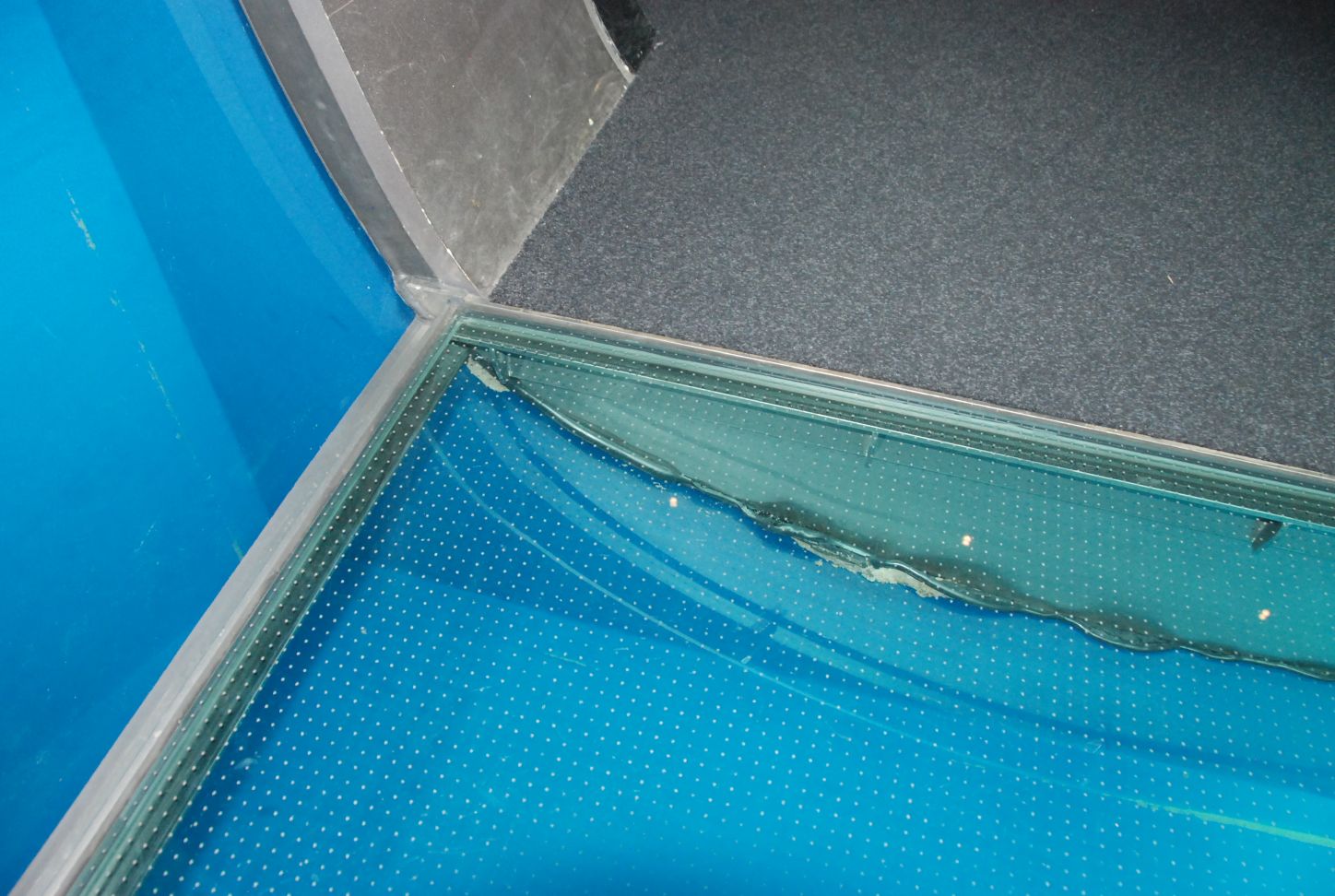
and a close up of the anti-slip - click image to enlarge

Below a shot through the acrylic hemisphere, and therefore distorted, but notice how light and transparent the floor appears, it almost vanishes.

And two final photos showing the floor


Below: I did a quick, rough sketch of the layout of the underwater exhibit area.

I conclude the posting for the Spotted Seal exhibit with two videos:
unless noted otherwise.
Sunday, May 9, 2010
Chicago Millenimum Park (2 of 2) - water fountain and reflecting pool
Water is always fun. For all ages. The Crown fountain has it all: a waterfall, fun displays, reflection pool, feet-on interactive, benches for parents to watch. It was designed by the Spanish artist Jaume Plensa. Kids loved it. Bystanders loved. I loved it. It was fun to watch the changing display on the waterfall towers and to see kids and adults walk through the pool.
Here a video clip with kids running through the pool
Here the sculpture "spits" water into the pool
and one showing a different display
The photo below is taken against the bright sky and lets you see some of the support construction

And a couple more photos


And an artsy shot

And a last photo showing the pool edge in detail - click on photo if you want to see it up closer.

I wasn't there at night but thought it might look cool in the dark.
And indeed check out the photos in this blog:
http://explodingdoughnut.blogspot.com/2009/04/millennium-park-at-night.html
and
the results of Google image research "Crown fountain at night"
and
YouTube
Here some background info from Chicago traveler
http://www.chicagotraveler.com/chicago_millennium_park_pictures.htm
Crown Fountain
At the southwest corner of the park (Michigan Avenue and Monroe Street) are twin 50-foot fountain towers. In addition to the cascading water, the towers display video images of various Chicagoans and lights. On warm summer days, children (as well as youthful- spirited adults) frolic in the shallow water between the two towers and delight in the spray from the fountains. The surrounding green area is a relaxing place to spread out on a blanket and read a book.
or go to Wikipedia's site for more details on this water-sculpture.
Here a video clip with kids running through the pool
Here the sculpture "spits" water into the pool
and one showing a different display
The photo below is taken against the bright sky and lets you see some of the support construction

And a couple more photos


And an artsy shot

And a last photo showing the pool edge in detail - click on photo if you want to see it up closer.

For all photos and videos above: @2010 wild-design.com
I wasn't there at night but thought it might look cool in the dark.
And indeed check out the photos in this blog:
http://explodingdoughnut.blogspot.com/2009/04/millennium-park-at-night.html
and
the results of Google image research "Crown fountain at night"
and
YouTube
Here some background info from Chicago traveler
http://www.chicagotraveler.com/chicago_millennium_park_pictures.htm
Crown Fountain
At the southwest corner of the park (Michigan Avenue and Monroe Street) are twin 50-foot fountain towers. In addition to the cascading water, the towers display video images of various Chicagoans and lights. On warm summer days, children (as well as youthful- spirited adults) frolic in the shallow water between the two towers and delight in the spray from the fountains. The surrounding green area is a relaxing place to spread out on a blanket and read a book.
or go to Wikipedia's site for more details on this water-sculpture.
Friday, May 7, 2010
Chicago Millenimum Park (1 of 2) - The Cloud Gate sculpture
Before continuing with posting about my Japanese zoo and aquarium travel I have to throw in two cool things I saw last weekend in Chicago.
Do you know of an interactive device that works for all ages and for all cultures and that brings awareness to oneself and to the environment around you without needing explanations, and that is also maintenance free
?
Answer
I found it in downtown Chicago in the Millennium Park: a mirror sculpture named the Cloud Gate also nicknamed "The Bean" by Indian-born British artist Anish Kapoor . It makes you aware of yourself, the people you are with, the reflected environment, and - most importantly - it is fun to engage with. You can't help waving your arms even if your are 50 feet away to see if you can spot yourself in this mirror sculpture.Answer


Photos below: you can't help but touching it


I couldn't resist either

I saw people of all ages and from all cultures touching this sculpture.
The best of all: it is not intrusive to the environment it is placed in. It doesn't draw attention to itself, like the Flamingo by Alexander Calder (not to say anything against this great sculpture), instead it reaches out (reflects) and makes you turn around and brings awareness to the reflected skyline. For me, that spells: environmental awareness - make the visitor see - really look, and wake them up to their surroundings - whether it is the skyline of Chicago or a piece of nature, an animal or a large heard of animals....
There must be way to apply this idea to zoos and aquariums....
Ray Robinson, a friend and former colleague of mine, once told me of a rainforest exhibit he visited in a zoo in Sweden where, when you crossed a bridge, there was a mirror installed to one side that not only gave the illusion of a larger rain forest area but it would also reflect your image back, and you could see yourself standing on the bridge in the midst of lush tropical vegetation. He loved it. I now understand why.
Here is a video clip of "The Bean" . It ends with a kid doing a handstand against the mirror wall.
It is truly the sculpture of the millennium. Don't miss it if you are in Chicago.
For all photos and videos above: @2010 wild-design.com
To quote Chicago-traveler:
http://www.chicagotraveler.com/chicago_millennium_park.htm
Kapoor Sculpture on SBC Plaza (Cloud Gate) video of "The Bean"
A major feature of Millennium Park is the 110-ton elliptical sculpture designed by the celebrated British artist Anish Kapoor, one of the most prolific and respected sculptors in the world. "Cloud Gate," the monumental sculpture located on SBC Plaza was named by the artist on June 29 when the final panel of the elliptical sculpture was installed.
The sculpture is forged of a seamless series of highly-polished stainless steel "plates" that create an elliptically-arched, highly reflective work with Chicago’s skyline and Millennium Park itself as a dramatic backdrop. Visitors will be able to fully experience the majestic nature of the work by literally walking through and around, as it was designed for public interaction. Inspired by liquid mercury, the sculpture is among the largest in the world, measuring 66-feet long by 33-feet high. More info...
Wednesday, May 5, 2010
360 degree viewing tunnel at Spotted Seal exhibit at the Shinagawa Aquarium Tokyo
The spotted seal phoca largha exhibit at the Shinagawa aquarium in Tokyo, Japan, offers great visitor views thanks to two 360-degree glass tunnels, and a large step-in all glass cylinder. There is also a flat acrylic glass panel of about 4 meter length and 2.20 meter height, and two hemisphere-shaped viewing windows. All transparent elements are made of acrylic except for the tunnel floor, which is made of glass.
For the seals I would have liked to see more water surface area, possibly with some water movement (wave machine or jets), and a larger beach area, but otherwise this exhibit had a lot going for the animals: exposure to the outdoors, and it is probably the deepest seal exhibit that I have seen in my life.
Here is a link to a video that gives a quick overview of the lower part of the exhibit.
©2010 wild-design.com
And another one:
©2010 wild-design.com
Here I am standing in front of the flat panel looking into the exhibit. There is a 360 degree viewing tunnel to either side, and two hemisphere windows straight ahead in the rockwork.
©2010 wild-design.com
I'm following a seal around.
 ©2010 wild-design.com
Stroller in the tunnel - above
The tunnel is not round but elliptic, which I think led to less distortion if looked straight at it. It also was good because there was no risk of hitting your head against the glass, or having to make it unnecessarily large because of the head height. Click on photo to enlarge.
 ©2010 wild-design.com
Step-in cylinder - above
Here I am standing in the center of the exhibit in a room with glass all round and above except where the two 360 degree viewing tunnel connect. You can see the concrete support structure for the tunnel on the right (black). The ceiling is slightly tilted - you can't see it well in the photo, or even notice it while visiting, but when I reached up I could tell that the ceiling was from about 2 meters to 2.2 meters on the high end near where the two 360 viewing tunnel connect.

Kid on glass floor - above
A kid is standing on glass. The surface has some anti-slip feature. I'll post detail photos soon.
The layout and the viewing would make this a great penguin exhibit. The only problem is the height difference between above and below water viewing. At the Shinagawa Aquarium they solved this with a staircase for the main visitor flow and an elevator for wheelchairs and strollers. The day I was visiting, on a Sunday afternoon in April, it worked quite well but neither solution is ideal for large crowds.
bubble machine
A bubble machine doesn't sound very exciting and yet I thought here at the Shinagawa seal tank it was effective, inciting and mesmerizing. Adding a nice touch to the tank. The machine throws out bubbles that if the water is calm turn into beautiful circles on their way up. And every other minutes it erupts with a bubble curtain. Best of all: I can't imagine this being expensive or high maintenance.
When I was there the seals where so active that most bubble circles broke up pretty fast - but who cares if you get to see beautiful seals zooming by. But when there was a moment of calm it gave you something else to look at until the next animal came racing around.
I found a video below, done by slaiyee that gives you a good impression of the bubble machine.
There are lot more details and other features to this exhibit. I will post them within the next couple days.
For the seals I would have liked to see more water surface area, possibly with some water movement (wave machine or jets), and a larger beach area, but otherwise this exhibit had a lot going for the animals: exposure to the outdoors, and it is probably the deepest seal exhibit that I have seen in my life.
Here is a link to a video that gives a quick overview of the lower part of the exhibit.
©2010 wild-design.com
And another one:
©2010 wild-design.com
Here I am standing in front of the flat panel looking into the exhibit. There is a 360 degree viewing tunnel to either side, and two hemisphere windows straight ahead in the rockwork.
©2010 wild-design.com
I'm following a seal around.

Stroller in the tunnel - above
The tunnel is not round but elliptic, which I think led to less distortion if looked straight at it. It also was good because there was no risk of hitting your head against the glass, or having to make it unnecessarily large because of the head height. Click on photo to enlarge.

Step-in cylinder - above
Here I am standing in the center of the exhibit in a room with glass all round and above except where the two 360 degree viewing tunnel connect. You can see the concrete support structure for the tunnel on the right (black). The ceiling is slightly tilted - you can't see it well in the photo, or even notice it while visiting, but when I reached up I could tell that the ceiling was from about 2 meters to 2.2 meters on the high end near where the two 360 viewing tunnel connect.

Kid on glass floor - above
A kid is standing on glass. The surface has some anti-slip feature. I'll post detail photos soon.
The layout and the viewing would make this a great penguin exhibit. The only problem is the height difference between above and below water viewing. At the Shinagawa Aquarium they solved this with a staircase for the main visitor flow and an elevator for wheelchairs and strollers. The day I was visiting, on a Sunday afternoon in April, it worked quite well but neither solution is ideal for large crowds.
bubble machine
A bubble machine doesn't sound very exciting and yet I thought here at the Shinagawa seal tank it was effective, inciting and mesmerizing. Adding a nice touch to the tank. The machine throws out bubbles that if the water is calm turn into beautiful circles on their way up. And every other minutes it erupts with a bubble curtain. Best of all: I can't imagine this being expensive or high maintenance.
When I was there the seals where so active that most bubble circles broke up pretty fast - but who cares if you get to see beautiful seals zooming by. But when there was a moment of calm it gave you something else to look at until the next animal came racing around.
I found a video below, done by slaiyee that gives you a good impression of the bubble machine.
There are lot more details and other features to this exhibit. I will post them within the next couple days.
Saturday, October 11, 2008
Subscribe to:
Posts (Atom)